Artist Statement


"Painting is a study of our existence, spirit, and environment, derived from experiences in life. I choose objects that evoke childhood memories, create situations of atmospheric mystery, and bring visual interest through interaction. I’m intrigued by subtle shifts in value and color; yet seek a personal interpretation of the objects rather than a replication. Personality is revealed through the process of painting. Abstract remnants from my process remain visible in the final product. The hand must obey the spirit. "

January 22, 2012

New American Paintings interview

THE PERSONAL AND PERSONIFIED: PAINTING WITH CHELSEA JAMES by New American Paintings January 18, 2012, 8:15 am

1-james-bookshelf.jpg

Painter Chelsea James (NAP #96) captures everyday scenes that are soft and enduring. Personal nooks, quiet contemplative spaces and belongings, and everyday interiors are captured in a warm and nostalgic light. Something about her work makes me want to live in these homes and spaces she both creates and reflects upon. – More by Los Angeles Contributor, Ellen Caldwell, after the jump! Ellen Caldwell: Please tell me a little bit about your pieces featured in the recent NAP #96 issue.
Chelsea James: “Bookshelf” and “Sylvia” are scenes taken from an art professors’ personal studio bookshelf. Objects were collected from the desert for their peculiar beauty, some sentimental articles and others purely for utilitarian storage. I find it fascinating what they chose to display. The sink is from the Guthrie Building in SLC, which is an artist studio space. Artists’ spaces are alive with interesting marks and traces from occupancy and resonate with the energy of creating. I thrive off of that.
EC: Yes, I love this idea of stored momentum and traces of a past owner or spirit. It’s something that Erin Payne’s works (NAP#93) really reference too. The intimate and soft domestic scenes you create are fabulous. What first led you to this subject and style?
CJ: About four years ago, I was primarily a still life painter and interiors seemed like the next natural step. It began when my husband and I were renting an apartment in Prague and I didn’t have all of my equipment to properly paint still lives, so I began to paint the interior of the apartment and I really enjoyed it. From there, I explored numerous types of spaces and naturally, my style began to evolve to a looser, more obscure approach.
EC: Your color palette is really subtle, but compelling. Does it shift depending on the subject and series, or do you usually tend to stay with the cooler colors?
CJ: When I begin a painting, I try to not to start with a particular color palette, instead allowing the colors to evolve organically on their own, especially with my landscapes. I choose colors that I naturally gravitate to, it is purely instinctual. But for a series, I will strive to maintain some kind of unity and cohesion with the color palette.
EC: Your subjects vary in one way, with your interiors and exteriors, yet your style and approach makes them feel familiar and similar…
CJ: I like the idea of exploring the imprint of life and occupancy in interior spaces. For example, shelves where people display their keepsakes, or the farewell of a dinner and the traces left behind. Working with conceptual landscapes and perceptual interiors is how I like to work, so I will continue to work on the two subjects simultaneously and hopefully come to a more loose and abstract resolve with my landscapes.
EC: You’ve lived abroad and traveled a lot. How has art you’ve seen impacted your work?
CJ: A couple of years ago, my husband and I visited the Paris Museum of Modern Art along with the Van Gogh Museum in Amsterdam. I was heavily inspired by Van Gogh’s landscape drawings; the simplicity yet and subtleties in his tonalities, and I was moved by Nicolas de StaĆ«l’s work at the Paris museum. He uses very bold areas of color to describe space in a minimalist way. After viewing these shows, I decided to change my direction as an artist: to take more risks and to stay true to myself.
— Chelsea James is represented by the Dolby Chadwick Gallery in San Francisco, CA. Ellen C. Caldwell is an LA-based art historian, editor, and writer.

January 7, 2012

Bakersfield Museum of Art - Shifting Lanscapes

Shifting Landscapes
Dec 8 - March 8

November 11, 2011

BMOA paintings Dec.8-March 8

Above
60" x 60"
oil on canvas
Wash
36" x 36"
oil on canvas
Still
60" x 60
oil on canvas
Season
60" x 72"
oil on canvas
Rise
12" x 12"
oil on canvas
Paragon
48" x 48"
oil on canvas
Found
12" x 12"
oil on panel
Flush
12" x 12"
oil on panel
Flurry
12" x 12"
oil on panel
Expanse
48" x 60"
oil on canvas
Basin
60" x 72"
oil on canvas
Balance
60" x 72"
oil on canvas

October 22, 2011

October 19, 2011

me precious.

I came across Chelsea James like most good things, by chance in the San Francisco Gallery ……

Her large-scale paintings of mundane objects bring you in with every layer of paint. Ms. James captures a bookcase as if it is breathing. The colors vibrate off one another then slowly pool into a faded color field, only to remember you are looking at a common bookcase. There is nothing common about it.

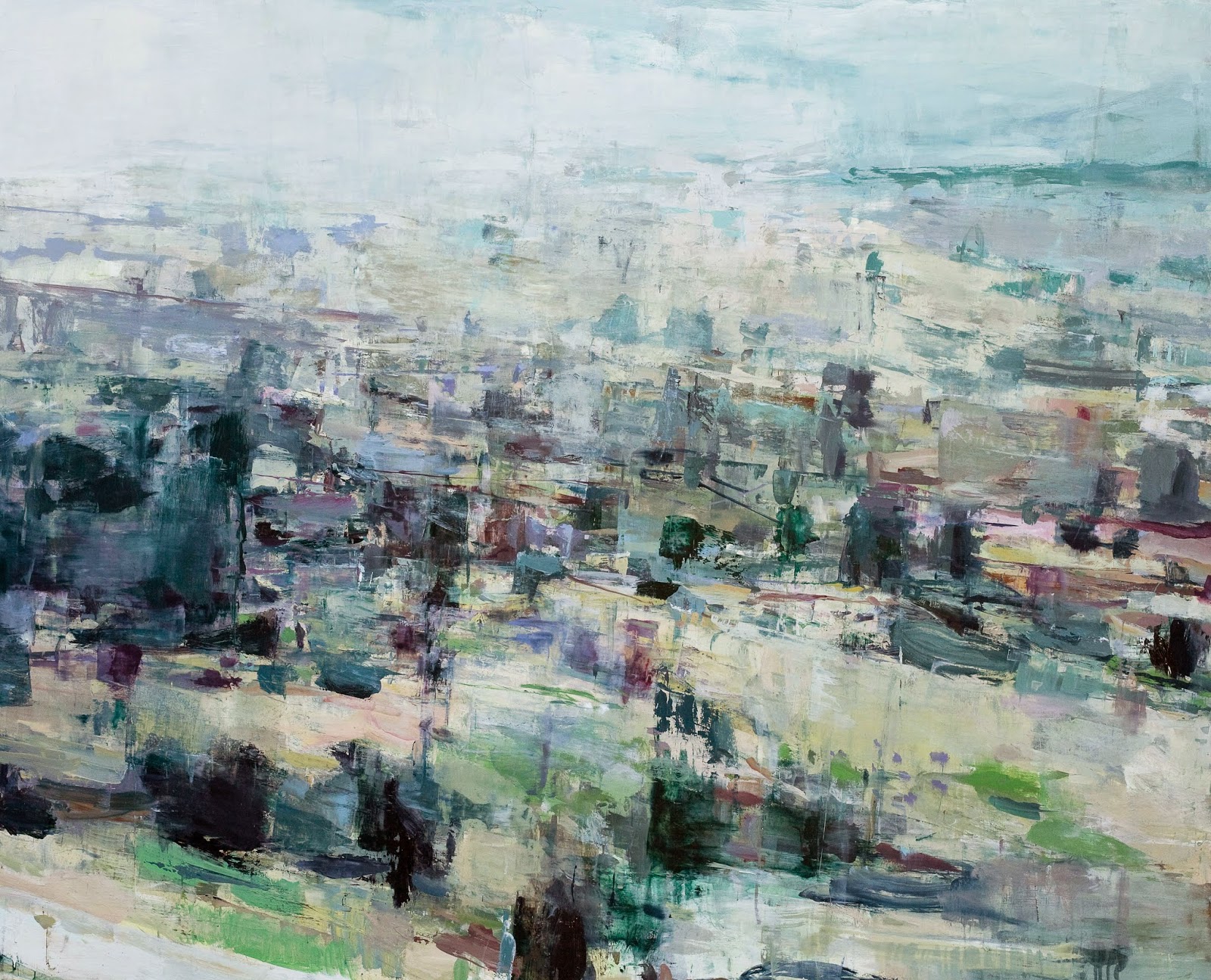
In her landscapes the ground raises up to meet the sky and disapears. The strokes across the canvas rush to catch a fleeting moment. The “fleeting” notion, seems to echo within her use of a quote from Hippocates, “Life is short, art long, opportunity fleeting, experience treacherous, judgement difficult.”

Ms. James continues: I paint for me, for that feeling of challenge, resolve, and completion. Oil paint is very complex, I feel as though I am at the beginning of understanding the intricacies of the medium. The possibilities are endless and I find that exciting. Being an artist enriches the way I see the world. When I paint something simple, I find that it’s infinitely complex. For example, when I am painting the landscape, I find that I notice little details that normally I would overlook, maybe the subtle value shift of colors in the clouds, or the edges and textures of the earth. My senses become more acute.

DT: Where do you get your inspiration?

CJ: I derive my inspiration from so many different sources. Art, travel, the landscape, architecture, Museums, photography, are just a few. Last year, Adam, Lulu and I drove from Amsterdam to France. I took thousands of pictures of the lush diversified landscape. This inspired me to try and paint the way that I saw the landscape, the way it made me feel. There is something very calming, infinite and alive about the trees, wind, and the landscape in general. But, I tend to gather inspiration wherever I am, and for that reason, I try to keep my eyes open.

DT: What is your process?

CJ: I sometimes begin with a loose drawing, generalizing areas with patches of color. It’s very rough; the objects are abstracted into shapes, mainly focusing on compositional elements and color relations. I then create unintentional marks to deliberately make mistakes, so that I can react, creating history and resolution in the process.

Mistakes can create beautiful moments that feel spontaneous, and free, rather than contrived. I try not to let my painting become precious. That is a dangerous thing, because then I am afraid to destroy it, to move forward. If the painting becomes dear, how can you progress without becoming tedious? It almost kills me sometimes, but when this happens, that is when I have to destroy it by making unintentional marks to free up the form. And then I go back to my painting and bring it back.

As she talks freely talks about her work she remembers a professor from college putting turpentine on a figure painting she was laboring over, while stating the importance to step back and to not commit too early in the process of a piece…

CJ: I was devastated at the time, but now that I look back, I realize that was a valuable lesson for me. It taught me to let go and have the confidence to find the form again. And usually, it is better the second time around.

DT: What draws you to your subject matter?

CJ: My landscapes and interiors seem to contrast one another, which keeps me interested. The landscapes are comprised from drawings, pictures, studies and memories, while the interiors are mostly perceptual, with only a little memory.

Rarely does a painting emerge quickly without the need to continually paint over it. It is not uncommon for me to be 80% completed with a painting and if it’s not working or I become bored, I either mess it up by throwing paint at it, or I completely paint over the surface and start over. Many of my finished works have at least a couple of paintings underneath.

I think it is important to find yourself involved in the process and not the product. The process should be alive, in motion, vulnerable. “Painting demands a certain mystery in which not everything is defined” – Degas

DT: What, if any compromises have you had to make?

CJ: It is a commitment, a time consuming investment, so you have to be very passionate. I have had to make many compromises with priorities, such as not getting a ski pass, or not going to that dinner party. I was working towards a show at Dolby Chadwick when I was pregnant and after the baby came. I had to make some very difficult compromises, like hiring help, and sleeping less.

DT: Who is your creative sounding board when you are stuck or in a loathing stage of a piece?

CJ: My husband. He is my most consistent and honest critique. When I feel stumped, or discouraged, he is the one that helps me believe in myself and he is not afraid to tell me the truth. Even though he is not a painter, he is very artistic and knowledgeable about art, and most importantly, I value his opinion.

DT: What is required of a Painter to float rather than sink in the industry?

CJ: To work hard, don’t give up and to not listen to outside negative criticism.

June 3, 2011

"Bookshelf 2"
36" x 36"
Oil on panel
"Cupboard"
24" x 24"
Oil on Panel

April 25, 2011

De Saisset show

LandsCApes: Glimpses of Everyday California
October 2 - December 5, 2010 and January 15 - January 28, 2011